 + 1-888-827-0150
 + 44-20-3006-2750









essay title help
UK Schools Reevaluate Sports Programs for Young Girls
Helen Fraser, chief executive of the Girls’ Day School Trust says that the UK’s current fitness programs at school need to be reevaluated. She says that the main hook or pitch currently being used to encourage fitness is that it sports will help make them more attractive. She says that this is counter-intuitive, especially in the all-girl school community. Ms. Fraser says that because of this popular notion, girls at school are almost scared to perform when it comes to sports: she says that they need to be taught that it’s a good thing to get sweaty and pink-faced in the interest of excelling at sports.
 In a speech at a faculty meeting of the GDST to take place next Wednesday, Ms. Fraser is going to present her proposal to the school board for a sports program that encourages camaraderie, excellence and sports-mindedness through a curriculum which utilizes material that centers around strong female role models. Her new sports education program also aims to show girls the health benefits of sports and exercise. Ms. Fraser says that she wants sports to mean more to young girls than a way to be perceived as attractive by the boys—she wants them to really enjoy the process of playing sports or of getting fit. One of the studies that Helen Fraser cites in her proposal is one conducted last year which shows that by the age of 14 only 12 percent of female students do the recommended weekly amount of sports and physical education. She also plans to share her vision with the rest of the faculty, saying she looks forward to talking into the locker room after Physical Education and hear girls talking about how the game went as opposed to how they looked while playing the game or how they look in the uniforms or fussing over how they look after playing the game.
Ms. Fraser goes onto say that sports and exercise are the only way through which women—beginning with the young girls who are still going through the process of learning about womanhood—can re-claim their bodies form the figure-obsessed media. The speech that she will be delivering Monday criticizes the interchangeability of the word fit with attractive or being fanciable. Ms. Fraser says she wants girls everywhere to realize that it isn’t about being fat or thin: it’s about being able to do more and to get stronger.
The GDST, which runs 24 private schools and 2 state schools is a great place for this kind of program to begin, Helen Fraser says. Because of its large but specific demographic, getting the GDST’s 26 schools behind this kind of initiative could mean great things for the program and for women everywhere. In addition to competitive team and contect sports, Helen Fraser also wants to introduce more alternative fitness practices such as Zumba, Yoga, Pilates, rock climbing, Tai Chi, rowing, golf, Taekwondo and trampolining—this way, girls who don’t necessarily like competitive sports can also be encouraged to take steps toward getting fit.
Among the women role models that are going to be cited in Helen Fraser’s GDST speech are Christine Lagarde, head of the International Monetary Fund who was once a member of the French National Synchronized Swimming team and Condoleezza Rice, the former United States Secretary of State—an accomplished golfer. She also wants to take a look at the kinds of criticisms that are usually used in women’s sports: while men are usually judged on their game play, women are often judged by how they look—for example, athlete Jessica Ennis was called “fat” by the media right before she won her gold medal.
The other members of the GDST say that they’re excited to see what Ms. Fraser’s speech is going to contain. Her innovative ideas and well-thought out frameworks could really help the future of sportsmanship and fitness in women’s education throughout the United Kingdom.
Being Good at Text Language Is Good For Learning
 Language has a very rich history of change—over the years, it has changed dramatically: in fact, if not for the studies of scholars in the academe, it might be near impossible for the 21st century layman to decipher Homer’s or even Shakespeare’s work on their own. A study conducted in 2012 by the New Media & Society Journal showed that the more adept one is at text language, the more frequent their grammatical errors. This study was conducted by students from the Wake Forest University and they studied a population of over a hundred kids ranging from the ages 14 to 16. For the past two years, fluency in text language has been heavily discouraged in most facets of the academe.
However, a more recent study conducted toward the end of last year which was recently published by the Linguistics & Translation Journal showed that being good at text language is actually good for learning because it helps students learn context. Roughly the same demographic was used, although slightly older kids were sampled with the age ranging from 16 to 18. By switching back and forth between conventional language and text language, students are able to increase their reading comprehension skills as well as their ability to read between the lines. Experts say that grammar is important and that for the text language-learning link to be effective, kids have to first learn how to use proper language, enabling them to switch between the two.
Researchers from the British Journal of Developmental Psychology have found that there is actually a positive correlation between language learning and fluency in text-speak. They urge the educational community to reevaluate their goals and open their minds to what this new kind of fluency could mean for the young people. It’s different, but it isn’t necessarily a bad thing. In their study, the researchers talk about the fact that writing as we know it is only 5,000 years old but that language and written communication itself (through hieroglyphics, for example) has been around for an estimated 80,000 years. While they don’t encourage doing away with the old, researchers say that it’s important for kids to be savvy at text language to be able to adapt to a fast-paced, technology-centered world. Another study published in the same journal has also showed that children who are able to master text language along with traditional language are more confident, more eager to speak out and generally do better in school. In fact, most of the world’s most successful young people have built their empires around technology.
The 2013 study by the Linguistics & Translation Journal shows that instead of discouraging text language, the only way for present language to thrive is to work in conjunction with it. Experts say that the evolution of language is necessary and with the advent of the internet, the present generation cares more about meaningfulness than they do about meaning. An example provided by the study was a text message that said something like “Running late see you later 1230”—there is no punctuation and yet we are able to decipher its meaning. The researchers reiterate that asking young people not to tolerate or not to understand this kind of language would also be asking them to develop a communication handicap. The important thing is to teach students how to switch between text language and traditional language. For example, teach them that it’s okay to write like that if they’re texting or writing notes to one another but that for an academic essay, this is unacceptable.
These studies are currently being reviewed for use in different high schools throughout the East Coast. Educators say that this could revolutionize their English programs and also garner more participation in high school students throughout the nation.
Medicaid Eligibility Leads to Fewer High School Drop Outs
A recent report by the National Bureau of Economic Research has found that expanding health care insurance lowers the number of high school students who drop out—especially in low-income communities. This has heightened the attendance rate in high schools throughout middle-America, resulted in higher college admission rates and overall, has bettered the likelihood of kids from low-income households attaining a bachelor’s degree.
 The study, which was a joint collaboration between Cornell and Harvard conducted earlier this year, examined academic performance throughout all eligible children, progressively keeping track of their educational attainment and livelihood from the 1980s, 1990s and early 2000s. The study concluded that the presence of proper medical insurance and free medical aid definitely resulted in long-term educational benefits: meaning a lot of the children who received this medical care were also very likely to pursue bachelor’s degrees and subsequent postgraduate studies. They were also more likely to get good jobs than kids who weren’t eligible for the free medical care.
When medicare expanded its eligibility by 10 percent in the late 1990s, the high school drop out rate decreased by 5.2 percent while the Bachelor’s Degree attainment rate increased by 3.2 percent and the college attendance rate rose by 1.1 percent: fairly good numbers for schools located in neighborhoods known for low educational attainment and gang life. The researchers argue that increasing Medicaid eligibility throughout the United States doesn’t just help address health concerns: it also helps students with their education (and ultimately, their lives) in the long-run.
There are two main categories to which this result can be attributed: first off is decreased risky sexual activity. The presence of Medicaid’s broad eligibility educates more high school students, warning them about the repercussions of Sexually Transmitted Diseases and unplanned pregnancies. They also showed that awareness of healthy activities decreased the incidences of obesity and mental health problems: the increased attendance also meant less kids out on the streets doing drugs. Being exposed to Medicaid at an early age has made kids aware of the dangers of binge drinking, smoking and eating unhealthy food: something which is priceless in today’s world of fast food and mystery pills.
Tangentially, the researchers reiterate what is rather obvious: that when kids and parents from low-income families worry less about having to spend on health care, they’re able to focus more on improving their quality of life through advancing their careers and make sure that their kids are educated—especially in rough neighborhoods, rural settings and communities where the majority of residents are from ethnic minorities. As of last year, roughly 10 percent of kids in the United States—7.9 million, specifically—remained uninsured. However, 70 percent of kids aged 10 years old and below were insured as of 2013 and a significant amount of those still uninsured were at least eligible for coverage from Medicaid, under the Children’s Health Insurance Program. This study was conducted in line with the recent Affordable Care Act and Harvard and Cornell’s initiatives toward raising awareness both for health and the importance of education.
Inner City Chicago High School Celebrates Its First College Graduation
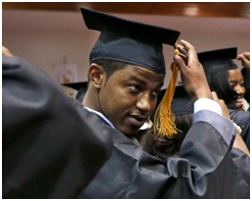 Urban Prep in inner-city Chicago is a charter high school that caters specifically to young men from disadvantaged childhoods. A huge part of their population consists of young, African American men who have been victims of tragedy and were at one point or another, a part of gang life. Most of these young men had no money—for example, Jamie Boldian, one student only had $17.91 to his name back in the year when he started at Urban Prep, 2010. Beginning in 2006 and beginning operations in 2010, the Urban Prep school decided to dedicate itself to helping these young men from Chicago’s inner-city neighborhoods turn their lives around and succeed—in a promise that binds the school to student, the exchange is simple: if they finished their classes at Urban Prep, stayed disciplined and left the gang life behind, then they would get into college. And surely enough—today, four years later, the Urban Prep school has reaped sweet victory: all of the members of their 2010 pilot class graduated from college last week.
Tim King, the founder of the Urban Prep school was brought to tears as he recently witnessed Kirshaun Branch, a former gang member who had left the Urban Prep school before coming back once he’d witnessed a tragedy, accept his bachelor’s degree from Frisk University. Mr. Branch is the first alumnus of the school to receive his bachelor’s degree. Kirshaun Branch grew up on the south side of Chicago: impoverished, underachieving in school and hot-tempered. With a long history of leaving school and getting into fights, things were not looking up for Kirshaun Branch. That is, until he was brought to his senses by the tragic death of a friend who was beaten to death in a gang fight. After this tragedy, he pleaded with the officials of Urban Prep to let him in: he had gotten dead serious and was set on procuring for himself a future that was very, very different from his past. At the end of that year, Kirshaun Branch became the president of the Student Government Association.
Mr. Branch, the school’s first college graduate and diploma holder, says that even when he got into college, uncertainty was always looming over him—while his academic situation had changed, his financial one had not. He was always worrying about money. He had a short fuse; he says that a lot of the time it was difficult for him to succeed because he hadn’t been raised to believe that this is what would happen to him. For as long as he could remember, he’d been told that he was doomed for failure: and a lot of the time, that seemed true. Kirshaun Branch says that he owes everything to his Urban Prep family. Long after he’d left the institution, they’d been there for him—fronting cash when he needed it, making sure they always kept in touch. Kirshaun is moved to tears as he talks about graduation and what a bachelor’s degree in Psychology would mean for him and his family: finally getting out of the Chicago south side, getting a job, finally having the means to live the kind of life that they deserve. He says that coming from Urban Prep was the first time that he’d ever had people who wanted him to succeed. The day before his graduation, Kirshaun had gotten a very emotional phone call from a good friend, congratulating him: the phone call was made from the Cook County Jail. Mr. Branch wipes his eyes as he thinks about it, saying he knows and will never forget how lucky he is to still be alive and to have gotten out of the gang life before it was too late.
The next step for Kirshaun Branch is to give back: he’s now working as a fellow at Urban Prep, mentoring freshmen at the school which now has three branches.
Another member of Urban Prep’s pilot college graduate batch is Robert Henderson, who went to college at Lake Forest College—one of Chicago’s most prestigious schools. He also graduated last week with a degree in History and American Studies. Like his former classmate Kirshaun Branch, the world hadn’t been kind to Robert Henderson—his mother was run over by a car when he was 17 years old. He is the youngest of six children, all of who were raised by their grandmother and all of whom didn’t go to college. Mr. Henderson is the first in his immediate family to attain a degree. He recalls that the hardest thing about college—especially one as prestigious as Lake Forest College—was the fact that he didn’t have the same privileges that his classmates did. He couldn’t rely on his parents to come up with field trip money or to front cash to buy required materials. He had to work for all of his cash: he worked more than three jobs at a time—assistant librarian, security dispatcher, campus mail clerk, cashier. It was tough, he says but he wasn’t going down without a fight.
Graduating a member of Alpha Phi Omega, a member of the school’s much-feared rugby team and a member of the charity league at Forest lake College, the future is bright for Robert Henderson. He is moving to South Carolina to join City Year, a national service group that is part of the AmeriCorps program.
Tim King says that these are stories that need to be heard—and he’s extremely proud that these young men have proven that you can do whatever you want with the right mind-set and dedication.
5 Steps to Writing An Outline
 Outlines are very important—they help you stay organized and make sure that you come up with written work that is cohesive and that will make sense to your reader. Well-written outlines serve as great guides and can save you a lot of trouble in the long run, especially when your essay is long. In this blog post you’ll find 5 tips that are easy to follow and that will help you write essays that are engaging, informative and research-propelled.
Free Online Education Apps Revolutionize Modern Learning
 Coursera.org has, for years, been the leading website in MOOCs or Massive Open Online Courses. This has been due to the esteemed Universities with whom they have tie ups—Brown University and the University of Pennsylvania among them—and the diverse line up of their certified classes (from the Fiction of Relationship to Basic Computer Science to Postmodernism to Astrophysics). They also have (as the MOOC term suggests), an enormous capacity for students—each class can have up to a thousand people enrolled at a time. Their learning materials are also very engaging, being one of the first and only MOOCs to use actual video lectures and footage: literally a digital “classroom”, connecting two people in two separate places. Assignments are also made in real-time, with comments and discussions forum/boards-style encouraging interaction between the students taking the class. Once again, Coursera has upped its game by being one of the first to come up with a digital learning app that students can download on their phones and tablets—available on both Android and iOS—allowing them to take their lessons with them wherever they go. Coursera offers classes for free, with a fee charged only for select certificate courses wherein the certificate and the fee are both optional.
Their new app has sky-rocketed in downloads and has increased the volume of people signing up for classes on Coursera even further. Coursera creators and developers put a lot of thought into taking the digital learning platform to the next level. For instance, one has the option to search courses and enroll in them through the app. They can also stream the video classes or opt to download them in advance which the developers say will keep people from maxing out their data allowance while in transit or during the actual viewing of the videos. There are also very smart limitations placed on the app: for example, you can’t take tests on it or perform peer assessments. The developers say that this is because it’s difficult to focus in transit and they don’t want students submitting requirements or grading their peers in a rush.
The Khan Academy, which is a YouTube learning channel that focuses mostly on maths and the sciences have also recently come up with a downloadable app. However, this is only free on iOS—their app is fairly simpler, as the Khan Academy deals with mostly traditional topics, in a rather traditional way at least as far as technology is concerned: their videos run on YouTube. This operates on a streaming platform and is definitely more casual that Coursera’s although nonetheless, is effective. It automatically syncs to the student’s YouTube account, giving them points for watching the videos (aka “attending the lectures). The app allows access to more than 4,000 Khan Academy educational videos. The app for Android is still in the works.
One of the most highly rated online educational apps is MOOCs4U, which allows students to view course offerings across different platforms including Coursera, Udacity and edX. More a search engine for MOOCs than a MOOC app itself, this allows you to see whether or not the different MOOCs have a downloadable app and redirects you to their download site. Another interesting app which does something slightly different is GroupMOOC. This app is different from everything we’ve mentioned previously because it operates as a modern day filofax: you can organize your schedule, making it easy breezy for you to remember deadlines and when you need to be online to attend your classes on different platforms. It also allows you to sync your schedules with friends and/or classmates enrolled in the same classes.
These new developments from the MOOC community have boosted the literacy rate throughout the United States, making it easy for people everywhere to learn for free. As of today more than 10,000 students are enrolled in Coursera at a time, and the app has gotten tens of thousands of downloads on both the Google PlayStore and Mac’s AppStore. Whereas initially, MOOCs were built around mimicking traditional education modules and the infrastructure of a classroom, these newer developments now have traditional schools and educational institutions looking to mimic the efficient and portable nature of MOOCs. Across the United States this year, more and more schools have digitalized their learning through the use of E-books, online classrooms and the TurnItIn website. Educational officers, app developers and teachers everywhere have big reasons to get excited about the flourishing of education this year.
Schools Develop Curriculum Against Cyberbullying
The Facing History School in New York City has developed a unique new program geared toward eradicating the phenomena of cyberbullying—both on their grounds and outside it. Their new curriculum aims to inculcate within their students a culture of community, responsibility, prudence, participation and individual strength. The school developed the new program in partnership with Facing History and Ourselves, a professional development organization which focuses on developing progressive curriculum that is geared toward personal and academic growth.
 Cyberbullying is the phenomena in which severe and often anonymous degradation of a person’s self-esteem, morale and reputation are harmed via malicious comments, posts and graphic representations on the internet. Student Dayanara Romero, 17, experienced bullying during her sophomore year. Now a senior, she recalls her experience in support of The Facing History School’s new curriculum, saying that the really terrible thing about it was that the names were being listed on the internet, garnering likes and comments—not just spreading the information itself but also encouraging people to chime in. The really terrible thing about using social media as a bullying tool, Ms. Romero recounts, is that even people who don’t know you are able to form an opinion about you: they think you are who people say you are. She says the organizers of this new curriculum have reached out to her and have since held meetings which she believes have helped her heal and extend her help to other people who might be going through the same ordeal in school.
The curriculum’s execution consists of a period of advisory wherein each grade level focuses on a different aspect of maladaptive human behavior, touches upon how it has to do with cyberbullying and what corrective measures can be made to overcome it. For example, in one history class, Mark Otto, The Facing History School’s assistant principal was discussing Human Trafficking. He makes it relevant to the students in the classroom by stating that more than just a heinous crime, human trafficking is something that can be prevented, if only we take care to become more aware of our surroundings and the way that we treat other people. He links the two phenomena by mentioning the presence of a perpetrator, control, power and a victim—all of which are factors that we can do something about.
Another unique feature of this new program is that the teacher handling each advisory class doesn’t change: they progress with the students and are able to form strong ties with the students, seeing them throughout their education at The Facing History School. Daniel Braunfield, program associate for special projects at Facing History and Ourselves, says that the new curriculum really focuses on taking time out of your day to reflect on human phenomena, behavior and how these things can be affected by our willingness to open ourselves up to change.
One advisory period, for example, consisted of students watching a video about a young family in the 1960s—the young girl watched her parents attack school busses. Jeffrey Galaise, The Facing School’s special ed coordinator and a teacher of English and History, says that more than just focusing on cyberbullying, their program wants to teach their students how to stand up for equality and wants to ingrain in them the desire and ability to speak up against injustice. He goes onto say that the final product of their curriculum is empathy: they want their students to be able to feel for others: a lot of the time the best way to get there is through indirect subject matter found in the arts—stories, films, poems.
However, the program also employs some methods that are definitely more direct. During some of the advisory periods, they study cyberbullying case studies and point out what could’ve been changed to affect the outcome of the case. Mr. Braunfield goes on to say that the truly fascinating thing about cyberbullying is that it doesn’t happen face-to-face; in most of the cases studied, the perpetrators and the victims had almost amicable interactions in real life which created a dissonance between the online social life and the incarnate social life. Mr. Braunfield says that on all accounts, cyberbullying is something deeply traumatizing that can be prevented through different simple tweaks in behavior. He and the rest of the faculty and staff at The Facing History School have decided to take on this ordeal.
NYU Seeks to Expand Institute of Fine Arts
New York University is currently the largest private university in the United States of America. Occupying more than five districts throughout New York, including its native Greenwich Village the education giant is now looking to expand even further. This time, N.Y.U. is looking to build in the Upper East Side, just a stone’s throw away from Central Park.
 The Institute of Fine Arts building belonging to N.Y.U. was founded in 1958, housing the graduate schools of art history, archaeology and art conservation—the 40,000-square-foot building located at the corner of 5th avenue and 78th Street was donated by Doris Duke, whose father James Duke was a titan in the cigarette industry. The next campus was donated 40 years ago by Sheldon H. Solow who himself dropped out of N.Y.U. but remained fond of it. This is located right beside the first Institute of Fine Arts, now called the Solow Building on 9 West 57th Street.
Mr. Solow also donated a smaller condo-converted space in 1989, this time 3 East 78th Street. This, today, remains unused because of its size and because there had previously been no need for the University to utilize it. While the school has a lot of campuses, the Institute of Fine Arts was one of the first and is the one which University Administrators feel needs to be enhanced. They are now ready to expand and to move into the donated space. They also want to buy the sunken alley beside it so that they can connect this campus to the Duke Building and the earlier Solow Building. N.Y.U. says that this would be great for their students because it would provide both safety and the cohesion of traditional, bigger campuses.
The Institute of Fine Arts is one of the most successful, renowned—not to mention oldest—colleges at N.Y.U. Back in the 1940s when the University was little more than a commuter school in Manhattan, the school made its name through producing talent and supporting (as well as being supported by) their alumni. In fact, it is a living testament to N.Y.U.’s persistence—Robert Venturi’s first commission was the restoration of the school itself. The school houses 160 students and 40 faculty members. The University hopes that along with their expansion, they can provide room for more students as well as improve the quality of education and the needed facilities for present students. N.Y.U. hopes to have the building up and running in two years. Negotiations to purchase the rest of the building in that lot are also in the works, amounting to a rumored $9 million which University officials say would be well worth it if it meant improving the educational experience of their students. They are now waiting on approval from the members of the neighborhood.
The response of their upscale neighbors has been mixed. While for the most part, the students and faculty—as well as the institution—have mostly had good relations with the people in their neighborhood, some of them have expressed concern over the fact that N.Y.U. wants to buy the back alley behind the buildings. This belongs to the city, according to Mr. Bozzi, a successful Hamptons homebuilder who is loathe to see the small strip of land given to the private institution. Ms. Rubin, an art conservationist, says that she is concerned about the alterations that the University will make to the landscape of the alley itself—a feature of the neighborhood which has been there for decades. David Price, a photographer who has lived across the street from the campus for 35 years argues that the students and faculty are very quiet and are absolutely unobtrusive. Frankly, he says, he is unsure what the fuss is about—as the alley is mostly utilized by N.Y.U. students anyway, he doesn’t see why they can’t buy it: this would mean student safety, not necessarily that other people wouldn’t be allowed on the strip of land. Mr. Price also goes onto say that it’s best that the land goes to N.Y.U., whose goal is furthering the education of its students.
Teri Slater, an N.Y.U. board member says that this expansion project is the future not just of the institution, but of all the students (present and incoming) who will be coming into the city seeking an education in the arts. She pleads with neighbors to look over their proposal, saying that safety and security of both the residents and their students will be taken into consideration. Overall, board members express their excitement over the school’s plans for expansions.
Oxford Study Says Videogames and Films Boost IQ
A study released by Oxford University last week states that watching films and playing computer games can positively affect IQ and vocabulary, especially in children. The films and games have been shown to expose the kids to new languages while simultaneously allowing them to learn how to adapt to new scenarios. Among the films and videogames used to conduct the study were Despicable Me 1 & 2, The Lego Movie, Minecraft and Flappy Bird. The study was conducted by experts, all of whom are members of the Oxford University Press.
 Among the findings of the study was that words used frequently in upcoming games and movies were used significantly more than words which didn’t regularly occur in popular game and movie culture. For example, a significant rise in the usage of words “ocelot”, “nether” and “spawn” has occurred in the past year, owing to the frequent occurrence of these words in Minecraft. “Minion” was declared the children’s word of the year—occuring more than 250 times in essays and non-fiction pieces written by the kids. These pieces were from BBC Radio 2’s 500 Words competition which challenges kids under 13 to submit creative written work. A total of 118,632 entries were submitted this year.
While previous popular research has warned that exposure to television, movies and gaming consoles is detrimental to children’s education, this new Oxford study has become the spectacle for debunking a study conducted last year which claimed that the exposure to gaming, films and shows dulls the young mind.
Vineeta Gupta, head of children’s dictionaries at the Oxford University Press says that older studies may have just been looking in the wrong places—using traditional markers for new skills. She says that this more interactive medium has definitely had a positive effect on the children’s IQ, especially where vocabulary is concerned. She goes onto say that it is very fascinating that children these days are writing about minions, portals and ocelots—things which they’ve never encountered in real life. She stresses the fact that even if these aren’t everyday words, the students were able to use them in correct context. Reading and comprehension has definitely grown, Ms. Gupta says—literacy begets the transformation of kids into better, more attentive readers. This development is in congruence with the fact that more recent videogames and films are better thought out and also have education in mind. She also adds that these games which are narrative-centered help kids learn about contingency and story-telling.
Along with this, the study also found that the kids used text-speak in their work: “OMG”, “BFF” and “LOL” all appeared in their written output—however, this was all in the context of telling a story (e.g. conversation) and not as a device to compensate for the absence of knowledge. Researchers also found complex words such as “blatherskite”, “tintinnabulation” and “collywobbles” occurring rather frequency in this year’s body of work. This year’s longest word throughout the entire competition is “pneumonoultramicroscopicsilicovolcanokoniosis”—a 45-letter word pertaining to an illness of the lungs which occurs as a result of the inhalation of very fine dust and ash.
Kate Nation, who is a professor of experimental psychology at Oxford University said that far from the earlier assumption that videogames and movies were stunting the growth of children’s imaginations, the stories which came in for this year’s contest were alive and extremely creative. She says that the visual representation of media may have instead upped the need for creativity and provided more stimuli for the kids to get creative with. She goes onto state that the kids were able to use old words in new and exciting ways.
They also noted that most of the work centered around current events—natural disasters, national holidays or events—and had a surprisingly resonant voice which talked about the effects of climate change and other big happenings on the human condition. This study hopes that their findings will find a way into the way that language, reading and comprehension are taught throughout the entire world.
President Obama Hosts White House Science Fair for Talented Young Scientists
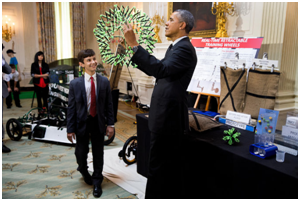 President Barrack Obama told the press the other day that he was glad that the White House Science Fair, now in its fourth year, was getting so much traction. After a meeting with the Seattle Seahawks the week before, the President told the press that the White House Science Fair stemmed from a belief that young, brilliant scientists, engineers and robot-builders need to be given as much credit as athletes, actors, performers and musicians. President Obama says that this event is one of his favorites that are hosted at the White House every year because it allows him to tip the balance in favor of those whose contribution to society is extremely important and also overwhelmingly underrated.
The exhibit ran from the Red Room through the Blue Room and into the State Dining Room. The kids in the exhibit were from schools from the seven top areas for STEM education in the United States—these are Allentown, Pa., Chicago, Philadelphia, Research Triangle Park, N.C., San Francisco and Wichita, Kansas. These seven areas are also going to begin mentoring programs which aim to foster relations between students and employees at companies like Cisco and Chevron. There are currently more than 200 companies in the roster.
Among the projects showcased at the Science Fair were a concussion-preventing helmet developed by a high school student after she dropped her cell phone and a catapult developed for self-athlete practice by a boy in junior high which engaged the President in a five-minute game of catch. Of all the young scientists present there, a few that stood out were a team of girl scouts who designed a bridge that could withstand flooding and an adolescent boy who looked dapper in a suit and had numerous pending patents for his other science projects and inventions.
This year’s White House Science Fair also presented an enormous opportunity for the STEM program and for all aspiring scientists, inventors and engineers—the President took the event as a chance to announce the $35 million competition that aims to train 100,000 STEM teachers and to bring quality STEM education to more than 18,000 students from underprivileged backgrounds. In keeping with the theme of uplifting STEM minorities, this year’s guest of honor was Kari Byron of the Discovery Channel program Myth Busters. Mr. Obama said that she represents the future of women in the STEM world: someone who is competent, relevant and constantly pushing the envelope with regard to science, knowledge and what is and isn’t possible. He also cited the fact that men outnumber women by half in the STEM world to date: this means that only half of the science team is being used to its full force. The President stresses that this has to be changed.
This truth was exemplified by the fact that the youngest scientist at the Science Fair was a 6-year-old girl who’d competed as part of more than 30 teams and represented more than 30 states. Furthermore, the team which this young scientist represented won national STEM competitions nationwide with research on cancer and influenza. Other students present were also on teams which came up with inventions that reduce the need for rare earth minerals in magnets and a robotic vehicle to rescue people from dangerous ocean waters. The President hopes that next year’s science fair will continue the tradition of the convention outdoing itself—he hopes that this lights a beacon of hope for young scientists from schools everywhere to keep raising the bar with regard to their education and practice.
